
AI for Teachers (Finally!)
What the new free teacher tools actually change

Smart Teaching Evolved - Issue #29
Thursday, July 16, 2026
Welcome back to Smart Teaching Evolved, where we cut through the AI hype to find what actually works in real classrooms. It has been six weeks since the last issue, and I picked a strange six weeks to go quiet. Here is what happened while we were at the pool (and in Mexico): the two most capable AI models ever released to the public both launched, both got pulled offline under federal export controls, and both came back with new restrictions. If that sentence sounds like it belongs in a foreign policy briefing instead of an education newsletter, that is exactly the point of this issue.
This is a double issue. We are covering the new frontier models from Anthropic and OpenAI, Google’s quieter but arguably more classroom-relevant Gemini push, what these tools can now do, and then the piece that matters more than any model release: how to read AI news about “students” when nobody tells you which students they mean.
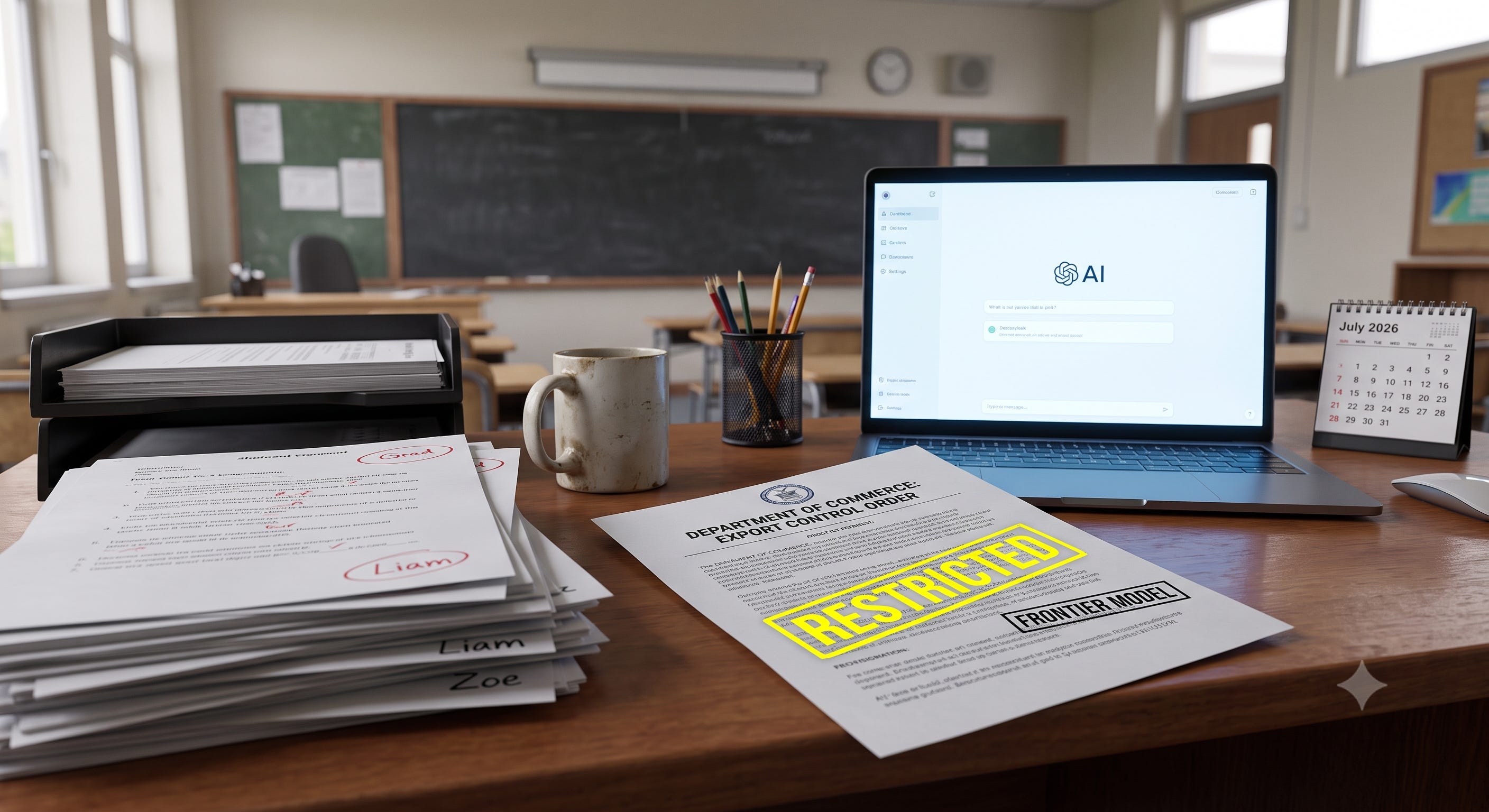
Intro to AI: The Summer the Government Paused AI
Two stories, told plainly.
Claude Fable 5. On June 9, Anthropic released Claude Fable 5, the first model in a new tier the company calls Mythos-class, sitting above its previous top model. Three days later, the U.S. government applied export controls to it after researchers found a way to bypass its cybersecurity safeguards. Anthropic suspended access for everyone because it had no way to verify who was using it. On July 1, after the controls were lifted, Fable 5 came back with stronger safety classifiers that now block more cybersecurity requests, sometimes routing even routine coding questions to an older model.
ChatGPT 5.6. OpenAI previewed its GPT-5.6 family on June 26, and at the government’s request started with limited access for vetted partners before the public release on July 9. The family comes in three tiers with new names: Sol (the flagship), Terra (the middle option), and Luna (the fast, cheap one). OpenAI says its new cybersecurity safeguards block roughly ten times more potentially harmful activity than previous models. Alongside the models, OpenAI launched ChatGPT Work, an agent that pulls context from your connected files and apps to produce documents, spreadsheets, and presentations.
Notice the pattern. Both companies shipped their most capable models ever, and both paired them with the heaviest restrictions they have ever applied. The federal government inserted itself into both releases. A June executive order now asks AI developers to give the government pre-release access to frontier models for capability assessment.
Here is the teacher’s lounge translation: the tools sitting in your classroom stack are now powerful enough that they get treated like sensitive technology. Not marketing copy. Regulatory fact.
And here is the hesitant optimism part, because you know I always carry both. The same capability jump that worried the Commerce Department also means these models finally read a chart correctly. Longtime readers remember Issue #25, where an AI-generated cell diagram labeled organelles with confident nonsense. Fable 5 and GPT-5.6 both made major gains in vision, meaning they can extract accurate information from diagrams, charts, and tables buried in PDFs. The models got more dangerous in a lab and more reliable at your desk in the same release. Both things are true, and pretending otherwise in either direction is how you lose your audience’s trust.
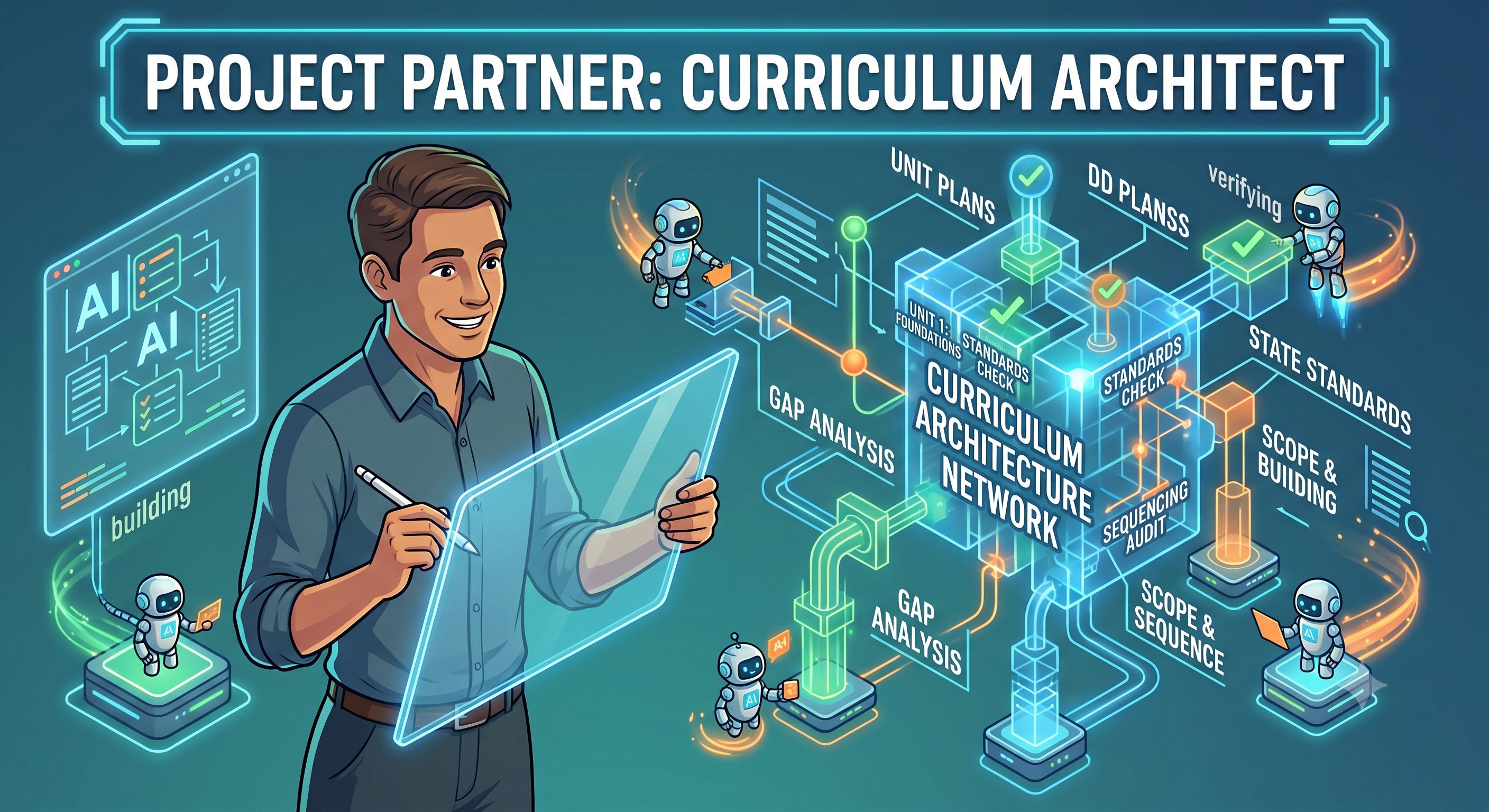
Innovative Use: From Task Helper to Project Partner
The real capability change this generation is not smarter answers. It is longer work.
Previous models helped you with a task. You asked, they answered, you moved to the next thing. The new generation completes projects. Fable 5 can run for days on a single assignment, planning stages, delegating pieces to sub-agents, and checking its own output before handing it back. ChatGPT Work gathers context across Google Drive, Slack, and Notion and returns a finished deliverable instead of a paragraph of advice.
What does that mean for an educator who is not migrating a 50-million-line codebase this summer? Three uses worth testing before August.
The curriculum gap audit. Feed a year of your unit plans plus your state standards into one of these models and ask for a gap analysis: which standards get heavy coverage, which get one glancing lesson in March, and where the sequencing fights itself. This used to be a summer committee’s worth of work. It is now a first draft in an afternoon. The word “draft” is doing real work in that sentence. You verify every claim, because you are the one who signs the scope and sequence, not the model.
The document-heavy job you have been avoiding. Handbook revisions, policy comparisons across neighboring districts, grant narratives that need to cite your own strategic plan. The new models handle nested tables and charts inside PDFs well enough that this category of work finally makes sense to delegate for a first pass. Same boundary as always: institutional documents yes, student records never.
The higher ed version. Program-level syllabus review. Hand a model every syllabus in your department and ask where learning outcomes overlap, where they contradict, and where the reading load spikes past reason in week nine. Department chairs, this is your pilot project.
The Gemini Lane: If Your School Runs on Google
Gemini skipped the export-control drama this summer, but Google made its biggest education push yet at ISTE in late June, and it deserves its own lane in this issue because it works on a different philosophy. Fable and GPT-5.6 are frontier generalists that connect outward to everything. Gemini has fewer connectors and is bound tightly to Google’s own architecture: Classroom, Docs, Drive, Chromebooks. If your district lives outside the Google ecosystem, that is a limitation. If your district lives inside it, and most K-12 districts do, the tight binding is the feature.
Here is what is practical right now.
Gemini in Classroom is free for every educator with a Workspace for Education account. More than 30 tools: convert a file into a Classroom-ready rubric in seconds, generate audio lessons, re-level texts, draft quizzes with answer keys. If your school already pays for Google, you already own this. Start here before your district buys anything else.
The new Classroom app in Gemini is the connector that matters. Rolled out at ISTE, it securely pulls your actual class context, meaning your assignments, grades, and materials, to do things like spot learning gaps across your last three assignments or draft a substitute plan that fits where your class actually is. Your data stays under the Workspace education agreement and is not used to train Google’s models. One flag for the grade-band section below: the Classroom app in Gemini is currently limited to education users 18 and over, which tells you Google is aiming it at you, not your students.
Teacher-led student experiences are rolling out over the coming months. Teacher-led NotebookLM, Guided Learning, and study notebooks let you pick the sources, put students in a space grounded only in your materials, and see insights on where they struggled. This is the supervised, teacher-mediated model that the grade-band framework below calls fair for younger students, built as a product instead of a workaround. Google is also extending it into Schoology and Canvas, so non-Google LMS districts get a partial lane too.
For high school specifically: study notebooks in Gemini now include no-cost, full-length SAT practice tests from The Princeton Review, with ACT and GRE practice coming. A diagnostic quiz finds the gaps, then the notebook builds adaptive lessons around them. For families priced out of test prep, this is a genuine equity story.
And one piece of actual evidence, which regular readers know I value over any press release. A study out of Sierra Leone followed 1,763 math students using Gemini’s Guided Learning over eight weeks. Students gained between 1.2 and 1.7 years of progress, climbing higher where teachers built it into about half their lessons. Across more than 113,000 interactions, Gemini handed over a direct answer in just 2 percent of its messages. The design detail that matters: teachers built the lessons, set the objectives, and led the discussions. One study in one context, so hold it loosely. But it is the clearest signal yet that AI tutoring works when the teacher drives and fails when the tool becomes an answer machine.
The honest limits: Gemini does not cite sources, math educators still catch calculation errors, and Google ships education features faster than it sustains them, so pilot before you build a curriculum on anything announced “in the coming months.” Verify your district admin has the right settings turned on before assuming any of this is live for you.
One more Google limit, and this one is not about the education tools. This week Common Sense Media rated the AI built into ordinary Google Search, AI Overview and AI Mode, as “Unacceptable” for kids, its worst rating. The distinction matters: those two features are baked into Search, cannot be turned off, and do not distinguish among ages under 18, so an 11-year-old and a 17-year-old get the same answer. Across more than 2,600 test searches the reviewers found they answered 100 percent of the homework questions students should have done themselves, returned inconsistent and sometimes wrong information, and missed signals of genuine crisis. The standalone Gemini chatbot your district can manage handled those same queries better, which tells you Google has the capability and has not applied it on the Search side. The practice that follows is concrete. For elementary research, send students to vetted databases and your librarian, not to Google Search. For older students, make the failure the lesson: run the same prompt twice, show the class how the answers drift, and use it to teach that a confident answer is not a correct one. Assume the Search AI is on, because you cannot switch it off, and teach around it.
A note on cost and access, because vendors will not lead with this. Fable 5 is priced at $10 per million input tokens and $50 per million output tokens, the highest price Anthropic has published for a generally available model, and the window of included access on paid Claude plans closed yesterday. GPT-5.6 Sol is available on paid ChatGPT plans, while free accounts get the more limited Terra tier inside ChatGPT Work. Gemini’s education tools ride along with Workspace for Education at no additional cost, which is a real advantage for budget-strapped buildings. The most capable AI in history is real, and so is the meter running next to it. For most classroom content work, the everyday models you already use remain plenty. Reserve the frontier models for the project-sized jobs above, and decide before you start what an afternoon of model time is worth against a week of your own.

The $0 Lane: What All Three Labs Now Give Teachers Free
Here is the news that matters most for your budget, and it broke while I was closing this issue. As of this week, all three major labs give verified K-12 teachers free access to their premium tools. Anthropic was the last through the door: Claude for Teachers launched July 14, joining offers OpenAI and Google already had running. If the meter I just described had you writing off the frontier tools as unaffordable, read this section first.
One rule applies to all three, so I will say it once. These are teacher plans, not student plans. Each one verifies that you are an employed educator, and none is built to hand a child an AI account. That lines up exactly with the grade-band framework below.
ChatGPT for Teachers. Free for verified U.S. K-12 educators through at least June 2027 (OpenAI’s signup page now lists June 2028). Teachers, staff, administrators, and district leaders qualify; students do not. You confirm your employment through SheerID with your school email at https://chatgpt.com/plans/k12-teachers/ , then you get a shared workspace colleagues can join, with admin controls for whoever claims the district domain. Nothing you put in it trains OpenAI’s models by default, and it is built to meet FERPA. The catch worth knowing: the free workspace runs an older model tier, not the brand-new flagship I opened this issue with. For lesson planning and materials you will not notice. For the project-sized jobs above, you might.
Claude for Teachers. This is the new one. Anthropic opened free access to its premium Claude tier, the plan that runs $20 a month for everyone else, to verified U.S. K-12 educators this week. Sign up by June 30, 2027 and you get a full year. https://claude.com/solutions/teachers What makes it more than a free license: it connects to a standards library covering all 50 states, so a lesson plan comes back already mapped to what your state expects, and it ships with teaching skills built and tested with classroom teachers. Training is off by default for educator accounts, the terms are FERPA-aligned, and there is a stated deletion timeline for any conversation that contains student data. One year, then we learn what it costs.
Gemini for Education. Google’s is the one you may already own without knowing it. If your district has any Google Workspace for Education edition, Gemini for Education, NotebookLM, and Gemini in Classroom are included at no additional cost, which is the Classroom toolset I walked through in the Gemini lane above. If your district pays Google nothing today, an institution can still sign up for the free Fundamentals edition and switch Gemini on. The fine print here is about age, not eligibility. The richest features are gated to users 18 and over, and your admin has to enable access app by app. Your data stays under the Workspace for Education terms and is not used to train Google’s models.
The honest summary: the frontier flagships still cost real money by the token, and that section stands. But the everyday premium tools, the ones that actually do your lesson planning, differentiation, and materials, are now free for teachers across all three labs, on privacy terms the consumer apps never gave you. If you have been paying $20 a month out of your own pocket for any of these, stop this week and verify instead. Two things to keep in front of you: every one of these is a teacher tool with a verification wall and a renewal date, and the free tier is not always the newest model. Check what you are actually being handed before you build a semester on it.
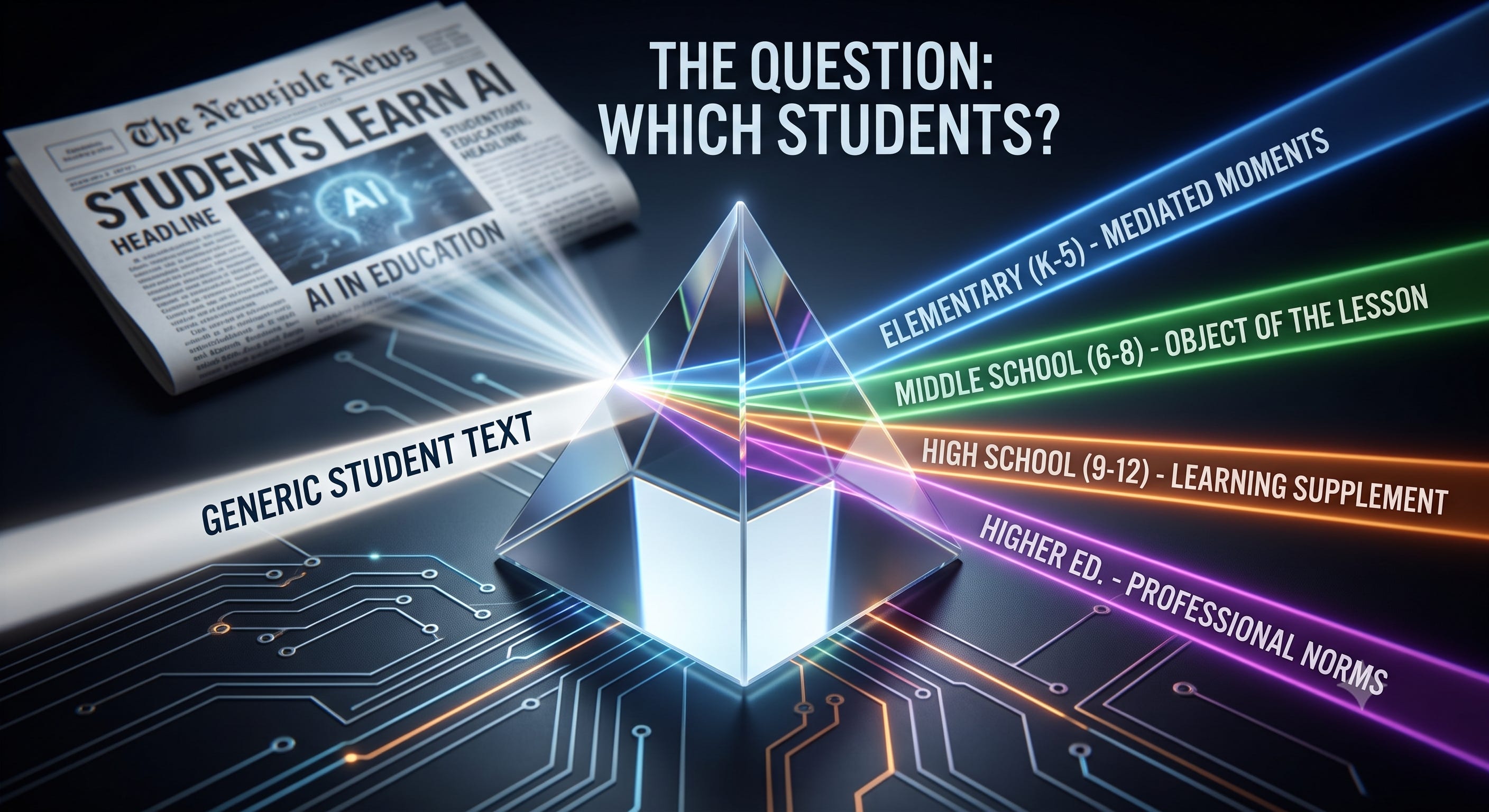
The Question to Ask Every AI Article: Which Students?
Now the part of this issue I care most about.
Sometime this month you will read a headline like “Students are using AI to cheat” or “AI tutors are transforming how students learn.” Stop at the word students. The article almost never tells you whether it means a 7-year-old, a 13-year-old, a 17-year-old, or a 20-year-old. And every single question that matters, legal, developmental, and pedagogical, changes completely depending on the answer.
Regular readers know the framework we built in Issue #28: schools, teachers, and students are three different users with three different risk profiles, and “students” itself splits into developmental bands. This issue puts that framework to work as a reading tool, because the back-to-school coverage wave is coming and most of it will blur these lines.
Start with the legal floor, because it is more concrete than people realize. COPPA restricts data collection from children under 13, which is why general-purpose chatbots are not built for elementary students. As of this writing, OpenAI’s terms require users to be at least 13, with parental permission required under 18. Anthropic’s consumer terms require users to be 18. Sit with what that means: by the companies’ own rules, most of the K-12 population should not have direct, unsupervised accounts on the most talked-about AI tools. That single fact reframes half the coverage you will read this fall.
Now the bands, with what is fair and what is not so fair at each level.
Elementary (K-5). Fair: the teacher using AI to build leveled readers, differentiate materials, and draft parent communication. Students encountering AI only through teacher-mediated moments or purpose-built, COPPA-compliant tools designed for children. Not so fair: putting a general-purpose chatbot in front of an 8-year-old, AI companion apps marketed at kids, or any tool that collects data on children to function. At this age, AI literacy means the teacher narrating her own use out loud: “I used a computer helper to make three versions of this story, and I checked all of them.” It should not mean these children have access to AI tools directly.
Middle school (6-8). Fair: structured, supervised AI literacy lessons where the teacher drives. A biology teacher in California has students ask a chatbot to describe an animal’s traits, then verify the output against reliable sources, deliberately teaching that AI gets things wrong. That is the model: AI as the object of the lesson, under supervision. The teacher-led Gemini experiences described above are built for exactly this arrangement, and they come with usage insights so the supervision is real, not assumed. Not so fair: unsupervised homework-helper accounts, students misrepresenting their age to access consumer tools, or AI evaluating student work without a human in the loop.
High school (9-12). Fair: disclosed AI use for brainstorming, research starts, and revision, at the teacher’s discretion, assignment by assignment. This is the approach districts like Columbus City Schools locked into policy this summer: AI as a learning supplement, with teachers deciding per assignment and undisclosed use treated as plagiarism. AI literacy coursework counts here too, since several states are moving to require it for graduation. Not so fair: submitting AI work as your own, AI making high-stakes calls about grades or discipline, and students uploading classmates’ work or personal information to any tool. Honestly, we know students are using these AI tools including SnapAI (from Snapchat), or GrammarlyAI whether we want them to or not.
Higher education. Fair: treating students as the emerging professionals they are. Discipline-specific norms, clear disclosure expectations, and faculty who model their own AI use instead of hiding it. Not so fair: blanket bans that pretend the workforce these students are entering does not exist, and enforcement built solely on AI detectors, which still flag human writing often enough that they should never be the only evidence in an integrity case. I will have more on higher education and AI in later issues.
And the teachers themselves, because we belong in this grid too. Fair: content creation, differentiation, and drafting feedback that you personalize before it reaches a student. Not so fair: AI-written report card comments sent out unreviewed, AI grading student work without your judgment applied, or student data pasted into consumer tools. Longtime readers know the “by Gemini” story from Issue #22. Do not become that story.
So here is your filter for the fall coverage wave. Every AI-in-education headline gets three questions before you share it, worry about it, or bring it to a staff meeting:
Which students? Elementary, middle, high school, or higher ed. If the article never says, its conclusions apply to nobody in particular.
Which user? Is this about the school as an institution, the teacher as a professional, or the student as a developing learner? Those are three different stories wearing one headline.
Which use? Is AI assisting a human, substituting for one, or evaluating one? Assistance is usually fair game. Substitution needs scrutiny. Evaluation without human oversight is where nearly every serious policy, from state bills to district rules, draws the hard line.
An article that survives all three questions is worth your time. Most will not survive the first one.
AI News Alerts
Policy deadlines stopped being hypothetical. Ohio’s mandate requiring every public district to adopt a formal AI policy took effect July 1. Maryland districts are now on a 120-day clock from the release of state guidance under the AI Ready Schools Act. FutureEd’s legislative tracker counts 71 bills across 27 states addressing AI in classroom instruction this session, including a South Carolina bill that would require written parental opt-in and ban AI from high-stakes student decisions without human oversight. If your district still has no policy, you are running out of company.
Teachers see this as bigger than the internet. A June NPR/Ipsos poll found nearly three in four K-12 teachers believe AI has larger implications for education than the internet or computers did. The same poll found 54 percent worry AI makes it harder for students to build critical thinking skills, and about half say their school has offered no AI guidance at all.
The policy clarity gap. Stanford’s 2026 AI Index reports that only half of middle and high schools have AI policies, and just 6 percent of teachers describe those policies as clear. A policy nobody understands is a liability document, not a teaching tool.
Model whiplash, resolved for now. Fable 5 and GPT-5.6 are both publicly available again, with the strongest safeguards either company has shipped. Expect occasional false positives where benign requests get blocked or rerouted. Both companies say they are tuning this. Your takeaway: if a model refuses something ordinary this month, it is probably the classifier, not you.
Teaching Tips: Three Moves Before August
Summer is your window to get ahead of all of this. Pick from these three, in order of impact.
1. Write your own “which students” one-pager. One page, your grade band only: what AI use is fair in your classroom, what is not, and how students disclose. Use the band breakdown above as your starting draft. If your district policy exists, align to it. If it does not, your one-pager becomes the thing you hand your principal when they ask what to do, and that is a better position than waiting.
2. Run one project-sized test on your own materials. Pick the curriculum gap audit or the document job you have been dodging. No student data, ever. Then grade the AI’s work like you would grade a student teacher’s: what did it get right, what did it invent, and would you have caught the inventions without checking? That last question tells you exactly how much oversight this generation of models still needs from you.
3. If you lead a building or district, check your state on the FutureEd tracker this week. Policy before purchase. Every vendor pitch you hear between now and September should be answered with your governance framework, not the other way around. If you do not have one yet, that is exactly the work my district clients and I spend July and August doing, and there are only so many weeks left before the buses roll. If your district is staring at a policy deadline, book a call at vossaiconsulting.com.
LeadershipAI meets this Thursday, July 16. We are working through exactly this: reading the new model landscape, the state policy wave, and what to put in front of your board before fall. Bring your draft policy, or bring your blank page. Both are welcome.
Next issue: Parent communication for the fall. What families are hearing about AI, what they are getting wrong through no fault of their own, and the letter you should send in week one.
Smart Teaching Evolved is published by Dr. Robert Voss, member of the OpenAI Academy Faculty, helping education professionals understand and leverage AI for student learning while keeping teachers at the center of great education. Got a question about the new models or your district’s policy timeline? Hit reply. I read every one.