
Differentiate your Teaching with AI

Smart Teaching Evolved - Issue #9
Tuesday, September 30, 2025
Welcome back to Smart Teaching Evolved—where we cut through the AI hype to find what actually works in real classrooms.
Personal confession: During my high school teaching days, I’d sit at my kitchen table at 9 PM, staring at tomorrow’s American History lesson plan. The core lesson was solid—my “middle of the road” kids would get it. But I needed something for Marcus, who could barely decode text, and something for Jose, who’d read the entire Harry Potter series seven times by fifth grade and had literally run out of books in our school library. My brain would just... stop. And when I couldn’t create those adaptations, Marcus would disengage and cause disruptions and Jose would doodle elaborate battle maps in his notebook margins. Real kids, real consequences. Maybe you know this feeling

.
This week: How AI breaks through that differentiation paralysis—with specific tools and techniques that actually work.
Personal Note: This edition is late because I got working on the new Claude release. More on that next week.
Intro to AI: The Differentiation Block Is Real (And It’s Not Your Fault)
I’ll never forget the Sunday night I spent four hours trying to adapt a lesson on the Civil War for my American History class. Four hours. For one lesson. By hour three, I was recycling the same tired strategies to “read with a partner” for struggling readers, “research another battle” for kids like Jose.
The worst part? I knew these weren’t good differentiations. They were cop-outs. Jose didn’t need to research another battle or write a report. He’d already memorized every military engagement from Fort Sumter to Appomattox. He needed to grapple with historiography, with why historians disagree about causes, with how we construct historical narrative. But my creative well was empty, and Monday was coming whether I was ready or not.
Here’s what I wish I’d known: Differentiation block isn’t about lacking skills. I could do it, but it always took a lot to get done. It’s about cognitive overload. Your brain literally cannot generate infinite creative variations for 150 students across five periods of Geography and American History. It’s not possible. You’re not failing—you’re human.
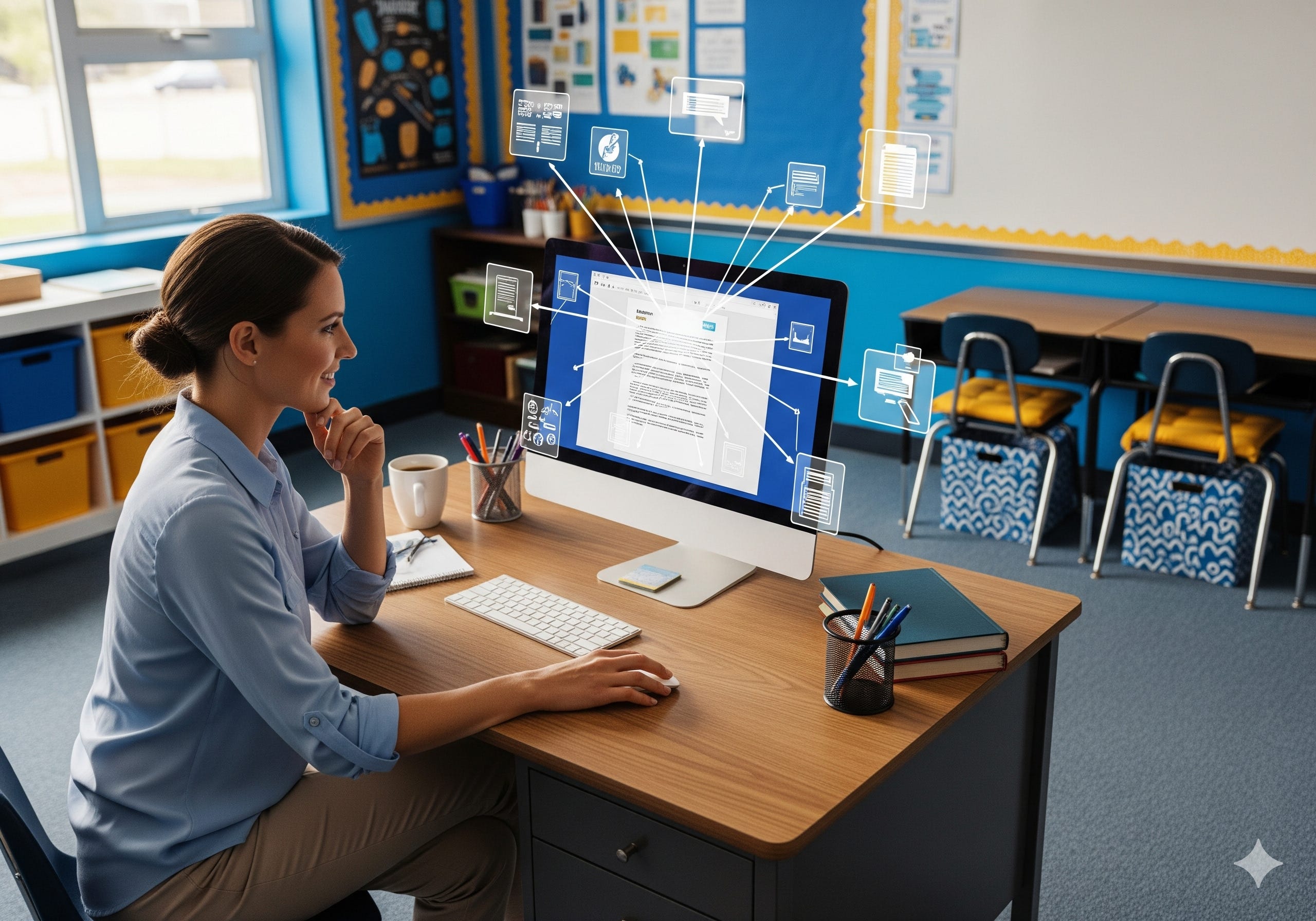
AI changes this equation. Not by replacing your expertise, but by handling the generative heavy lifting when your creativity tanks. You still decide what each student needs. AI helps you create it without burning out.
Think of it this way: You’re the historian who knows which sources matter and which perspectives need examining. AI is your research assistant who helps compile different versions for different readers.
Innovative Use: Real Tools, Real Examples from Social Studies
Let me show you exactly how this works with the tools you have access to right now.
ChatGPT 5
The power move: Using ChatGPT 5 ‘s “Thinking” mode for complex differentiation. This feature (available to Plus subscribers) shows ChatGPT’s reasoning process—crucial for educational adaptations. Even if you don’t use thinking mode, this can work.
Real example from my teaching days (recreated with AI):
Original lesson: Analyzing primary sources from the Great Depression
My prompt: “I need to differentiate this primary source analysis for a student reading at 3rd grade level but in 10th grade American History. Show me your thinking about maintaining age-appropriate engagement while adjusting complexity.”
What Thinking mode revealed:
ChatGPT considered the dignity issue of giving “baby work” to a teenager
It suggested using photographs and political cartoons before text documents
It recommended graphic organizers that look sophisticated but provide heavy support
The result: A lesson using Depression-era photographs with structured observation prompts, leading to simplified excerpts from FDR’s fireside chats with vocabulary supports embedded.
Claude’s Deep Reasoning for Advanced Students
This is where I wish I’d had Claude for students like Jose.
Actual prompt I tested: “I have a student who’s read every history book in our library. He’s in 9th grade Geography but thinks like a college student. Create an extension for our lesson on African geography that challenges him to think like a geographer, not just memorize more facts.”
Claude’s thinking process created:
A comparative analysis of how three different map projections distort Africa
An investigation into how colonial borders versus ethnic boundaries create modern conflicts
A mini-research project on why geography textbooks from 1960, 1990, and 2020 describe Africa differently
What Jose would have loved: Not more facts to memorize, but examining HOW we create and interpret geographic knowledge.
Google Gemini for On-the-Fly Adaptations
The game-changer is Gemini’s instant availability during teaching.
Real scenario I wish I’d had: Middle of a lesson on westward expansion, realize three students are completely lost while Jose is writing alternative history fiction in his notebook.
What you can now type directly in Google Docs: “@Gemini create three versions of this Manifest Destiny analysis: one with sentence starters and vocabulary support, one standard, one examining historiographical debates about American imperialism”
Instant results:
Struggling readers: Guided notes with maps, vocabulary boxes, and fill-in passages
Standard: Original lesson unchanged
Advanced: Comparing Frederick Jackson Turner versus Patricia Limerick’s interpretations, examining how historians’ perspectives shape our understanding
Time spent: 90 seconds versus my usual weekend scramble
AI News Alerts: The Integration Reality Check
Gemini in Chrome is everywhere now. Every student with a Chromebook has AI access. That “Help me write” button in Google Docs? Your students see it every time they open an assignment. It is in the browser by tapping “tab+enter”.
What I’m seeing in social studies classrooms specifically:
Students using AI to “summarize” primary sources (missing the entire point of source analysis)
Teachers discovering amazing differentiation support but paralyzed by policy uncertainty
History departments split between “this is plagiarism” and “this is the future”
From my consulting work:
Geography teachers are using AI to create differentiated map activities at multiple complexity levels
American History teachers are generating perspective-taking exercises that would’ve taken hours to create
Government teachers are using AI to simplify Supreme Court decisions while maintaining legal concepts
Critical for social studies differentiation: Browser integration means you can adapt primary sources in real-time. Student can’t parse the Federalist Papers? Simplify on the spot. Jose finished early? Generate historiographical questions instantly.
Privacy reality: Never input student names or specific learning plans. Use it for materials, not student data.
Teaching Tips: My Personal Social Studies Differentiation Workflow
Here’s exactly how I use these tools now when working with history and geography teachers:
The 10-Minute Differentiation Sprint for Social Studies
Start with YOUR solid lesson (2 minutes to review)
For struggling readers (4 minutes)
Prompt: “Simplify this primary source to 5th grade reading level while keeping these three historical concepts. Add context clues for historical terms.”
Copy the simplified version
Add visual supports
For your Jose students (4 minutes)
Prompt: “Create a historiographical challenge examining how three different historians interpret [historical event]. Include conflicting evidence and ask students to construct their own argument.”
Turn on Thinking mode to see connections
Add links to actual historian debates
My Social Studies Prompts (That Actually Work)
For struggling readers in history:
“Rewrite this primary source at 4th grade reading level. Keep the historical significance but use simpler sentence structures. Add context explanations for each historical reference.”
For executive function challenges in geography:
“Create a step-by-step guide for analyzing this map. Include checkboxes for each observation students should make and sentence starters for their analysis.”
For gifted students (the ones like Jose who’ve “read everything”):
“Design a historical debate where students must argue from primary sources that contradict each other. Include historian perspectives on why these sources disagree.”
“Create a geography challenge examining how three different cultures describe and map the same region differently.”
This Week’s Challenge From Me to You:
Think about your Jose—that kid who knows more history than most adults, who’s bored out of their mind with another worksheet on “causes of the Civil War.” Take 10 minutes. Use Claude or ChatGPT to create something that would make them think, not just remember.
Try this prompt: “Create a historical thinking challenge about [your current topic] that requires students to examine how this event is remembered differently by different groups and why those differences matter today.”
The Truth About Why This Matters
I think about Jose often. Brilliant kid who loved history but was slowly losing that love because I couldn’t challenge him properly. He didn’t need more facts—he needed to learn how historians think, how they argue, how they construct meaning from evidence. I gave him “extension work” that was really just more of the same.
And Savantae, who struggled to read but understood complex ideas when we discussed them? He deserved adapted materials that respected his intelligence while supporting his reading challenges. I gave him partner work and hoped for the best.
AI doesn’t fix everything. But when it’s 10 PM on Sunday and you need three versions of tomorrow’s lesson on the Constitutional Convention - one for Marcus, one for your core group, one for Jose - it helps you create what each student deserves.
You still provide the expertise, knowing that Jose needs historiographical challenge, not more facts. Knowing that Marcus understands causation but needs visual supports. AI just helps you execute when your brain says “I’ve got nothing left.”
Your boundaries remain critical:
No student names in AI tools
No IEP specifics or identifying information
Use AI for materials creation, not student analysis
Always filter through your professional judgment
Next week: We’ll tackle the thorny issue of AI-assisted parent communication—especially for those difficult conversations about student progress in subjects parents might not remember from their own schooling. We’ll talk about AI attribution and when to cite AI’s help.
Smart Teaching Evolved is published by Dr. Robert Voss, former high school social studies teacher turned professor and AI consultant. His work is at www.vossaiconsulting.com. Still thinking about your Jose? Hit reply—let’s brainstorm how AI can help challenge those brilliant kids who deserve more than busy work.